No grave marker for my cousin three times removed.
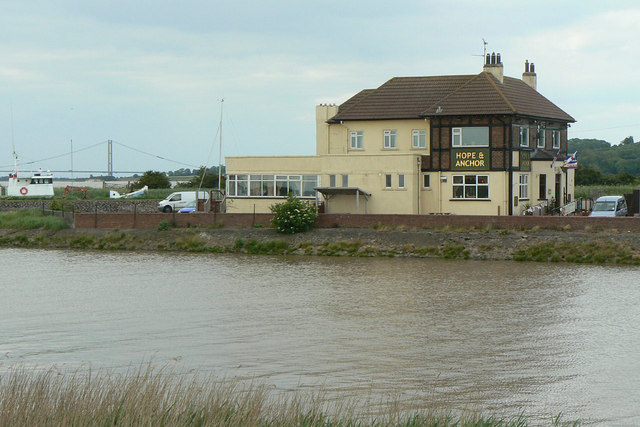
His death certificate gives his place of death as "170 miles NE x ENE of Spurn". Miles out at sea, far beyond where Spurn Point drizzles its thin finger into the wild North Sea off the Yorkshire Coast.
The date was etched on his family's memory.
6th February 1897. The day when a freak wave, attacking like a sea-monster from behind, stopped our George ever coming home to them from the fishing grounds.
His full name was George William Barrass. He was eldest child of my great great grandmother Charlotte's middle brother Samuel, who was a keelman like most of his kin before and after him.
 |
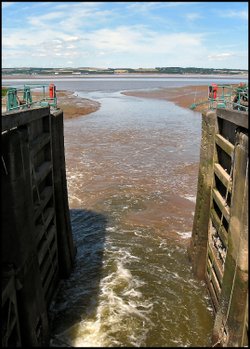
| Hull docks, on the North Sea coast of eastern Yorkshire at the mouth of the River Humber |
Samuel married George's mother Clara Clark, in 1861. She was a Lincolnshire lass, born near the famous landmark that dominates those flat acres, Boston Stump, at a tiny place called North Forty Foot Bank. Their family of six sons grew up on the sailing keels and around the docks in the port of Kingston-upon-Hull, at the sea end of the Humberhead Levels in bleak and beautiful East Yorkshire.
 |
| Boston Stump in Lincolnshire, the nearest town to where George Barrass' mother Clara Clark was born in 1839 |
The boys in order were:
George William (b 1864) the subject of this blog post, had to step up and look out for his younger brothers when, aged just 42, their father died of TB, and their mother, seeking solace in the bottle perhaps, as she was forced away from life on the ships to the fate of a poor charwoman, died of cirrhosis of the liver five years later aged 45.
Clark (b1867) named for his mother's maiden name, a lighterman on the Humber
Arthur (b 1870), who was already with his younger brother Alfred in the Seaman's Orphanage in Hull after his father's death, indicating Clara could not care for the older boys and could only look after the two youngest
Alfred (b 1872), a seaman; his army records from WW1 show he had brown eyes and was 5 feet 4 inches tall. He had a scar from an operation on a right scrotal hernia and like his brother Arthur, suffered from rheumatism and debility caused by exposure. He had a catalogue of misdemeanors during military service, including absence, fighting on guard mounting parade, using obscene language to an N.C.O., creating a disturbance in the barrack room at 10.10pm and disobeying an order, drunkenness, found in women's quarters contrary to standing orders and being absent from duty again. Then more drunkenness, not paying the proper compliment to a superior officer and insolence to the Company Sergeant Major. Never a dull moment with our Alfie! His character is still listed as "Good"!
Robert Sunter (b 1873) called after his maternal grandfather, a Lincolnshire shepherd. As his father couldn't spell, no doubt the Hull registrar of births couldn't make sense of the name "Sumpter" and Robert's middle name is the nearest approximation to the sound the clerk could arrive at from proud father Sam's instructions!
Samuel (b 1876), the baby of the family, taken under the wing of his eldest brother to be shown the ropes at sea. His life ended suddenly aged 31 when he accidentally fell from a waggonette in Hull and died the following day from fracture of the skull, laceration of the brain and haemorrhage. This makes his part in the tragic tale of his eldest brother George all the more poignant.
When George and Samuel signed on to be part of the five man crew on the fishing smack "Amy Isabel" and set sail with the Great Northern Fleet on 11th December 1896, George was the third hand and young Sam the deck hand on the fleeting fishing cruise. George left his wife Martha Jane and their little five year old daughter Ada ashore.
 |
| A Victorian fishing smack from the port of Hull |
Brothers George and Samuel and the second hand, Joseph Harrison were to crew the smack's little boat, 20ft long, 3ft deep and 6ft wide. The boat was in 19 fathoms of water. The sea was moderately choppy, but nothing to cause the seasoned sailors concern.
60 or 70 other ships in the fleet were all around them. What harm could they come to? The Admiral of the fleet, John Atkinson, skipper of the "Mountaineer", let the signal for "boarding" fish be hoisted at the foremast of the carrier ship "Eastward" to which all the fish from the various vessels would be rowed in little boats just like the one where the Barrass brothers were that morning.
The boat, fitted with a rope life-line, rove through the keel, extending fore and aft on both sides, set out towards the carrier ship. 17 boxes of fish were duly loaded and stowed on it and the launch went without incident.
 |
| Old wholesale fish market in Hull docks |
Joseph Harrison, second mate, was standing pushing the after oar, while young Sam, the deck hand, was pulling the forward oar on the port side. George, the third hand, was sitting keeping the boat stable in the stern sheets.
At around 9am, the 'Amy' lay at the port bow of the carrier steamer "Eastward", about 200 to 250 yards away. Her little boat had got half way across from their own ship to the "Eastward" when disaster struck.
Suddenly, Sam saw that a huge wave was rising threateningly behind them. He shouted to the other oarsman, Joseph Harrison on the starboard side:
"There is a heavy sea astern!"
Joseph looked round, and in his terror at what he saw, dropped the oar. Almost immediately, the huge wave rolled right over the boat and swamped it, sinking it instantly. It was never recovered. Neither were the boxes of fish or the oars. But these were the least of the losses that day.
When Sam spluttered to the surface, he was relieved to find George very close to him. He saw that Joseph Harrison was lying quite still and lifeless face down a few feet away from them. Nearby, like a saviour in a storm, he made out another little boat like theirs, the one belonging to the fishing smack "Smiling Morn," which had ridden the wave that sunk them. She was only a few yards away and surely within easy swimming distance.
The brothers swam towards the other boat. As Sam was pulled into it, with George only a foot or two behind him, he saw his brother sinking, exhausted from his efforts, only seconds from certain rescue. His body, and that of Joseph Harrison, was never recovered.
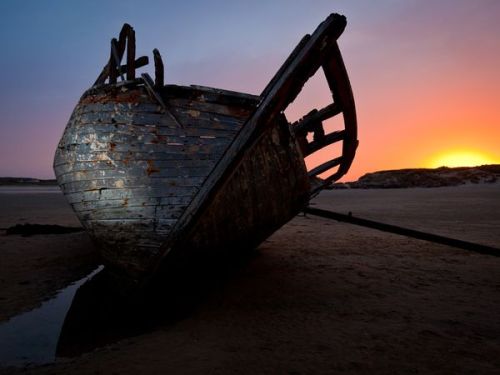
The 'Amy Isabel' returned to her home port of Hull, arriving two days later on the 8th of February. What it was like for Sam to be the only survivor, to tell the news to waiting friends and family, his sister-in-law Martha Jane and his little niece Ada, we can only guess. Seafaring families are used to tragedy. But nothing can prepare you for such losses when they intrude into your loved ones' lives without warning.
Sam gave evidence at the inquiry into the incident, which can be read here:
Report into the tragic loss of the 'Amy Isabel's boat and two members of her crew 6th Feb 1897
I wrote this song in the video below, in memory of the heroes who sail out to face the perils of the ocean. It's partly in the form of a lullaby for Ada, the little daughter our George left behind, sung from the point of view of his grief-stricken widow Martha.
Its images include the superstitions of the fishermen's communities, such as never saying goodbye or looking back so as not to incur bad luck on a voyage. Some wives even carried their husbands onto the ships so they didn't get their feet wet!
The final verse also mentions the superstition that a baby's 'caul', (that part of the amniotic sac that occasionally emerges on the head on a new born baby), is considered lucky. A caul was preserved in the maritime community as an object of wonder, believed to protect its keeper from drowning.
The title and chorus of the song is "Round, Round." I wrote it knowing that in singing it, the words could also be taken as "Drowned, Drowned,"and the meaning there is, of course, not unintentional on my part.
I sing it in tribute to my long lost distant cousin and all my seafaring and sailing ancestors, to whom I dedicate it with love and profoundest respect: