Showing posts with label Keels. Show all posts

Monday, 12 January 2015

Goatsucker Harvest: The watery wonderworld of the Humber Keel


“Rise your tack!” 

Thirza clung onto the tiller kicking against her, the neck of a huge oaken sea-monster butting her in the ribs. The calls of keelmen and women, wharfingers, the cough of wind in sailcloth, had been her lullaby since before she was born. Voices of salt and shimmering rainbows of sound whispered all around her. She'd heard it all from the snug shelter of her mother Dinah's womb. Back then she couldn't tell the womb's throbbing walls from the sea swell beyond. But she knew they were both her home." -(c) Joyce Barrass (2014) 'Goatsucker Harvest'  Kindle Edition. 

"Thistle," the Humber Keel in 'Goatsucker Harvest,' I named after the boat on which my 3x great grandfather, Samuel Barrass & his family were captain & crew on the night of the census 1881. I come from a long line of Barrass & Pattrick mariners, sailmakers, keel and sloop families from Doncaster, Stainforth, Thorne & Hull. They were born, lived, worked, played and often died afloat on canals such as the Stainforth & Keadby. They inspired much of Thirza's story, as the book's dedication reveals. 

I've had the joy of sailing on the restored-to-sail Humber Keel "Comrade" a few times, between Ferriby Lock & Hull. You'll see Comrade's mainsail & topsail on the cover of the book, one of the many photos I snapped while aboard. I even took a turn at her tiller under the Humber Bridge! As the skipper, Colin, wryly quipped: "Your Barrass ancestors would be turning in their graves!" Maybe. Though quite a few of them came to a watery grave down the years, faceplanting off boats, drowning, choking in the mud, colliding with the quayside or getting accidentally knocked senseless by the yardarm. At least I didn't ground her (quite!).

It was such a thrill & privilege to taste what my family's and Thirza's lives were like on the Yorkshire waterways. That's  thanks to the amazing volunteers of the HKSPS - 'The Humber Keel & Sloop Preservation Society'. See more photos & info on these historic ships on their site Humber Keel & Sloop Preservation Society website & FB page HKSPS Facebook page
The Yorkshire Waterways Museum at Goole (the "Venice of the North"!) is also a wonderful place to visit to learn more about this watery wonderworld.


Sunday, 21 August 2011

Ahoy there! Message in a virtual bottle!

Horace Barrass, nicknamed 'Pegleg' because of his homemade leg crafted from driftwood (not illustrated!). Photo via the Humber Keel and Sloop Preservation Society. They used a slide of this image in their 40th Anniversary exhibition in 2011. Photo enhanced by Mr D Mitchell, husband of my 6th cousin. Do you know the origins of this picture? The keels on the left appear to be the 'Lady Ina' and the 'Eccles John'. Do you know the names of the people in the photo? I would be SO grateful to learn more! (Photo taken in 1957 at Ferriby Sluice, Lincolnshire, according to writing on the back)


You might remember back in May last year, I told the story of my ancestor Horace Barrass, or "Pegleg" as he was affectionately known around Doncaster, Yorkshire and on the canals where he was a master mariner and keel captain sailing the local waterways between Sheffield and Hull.


Horace (1889-1976) lost his leg in an incident with wire as a young man, and later made his own substitute leg out of driftwood. This leg and its owner became a familiar sight in the area and something of a local legend!

A distant relative of mine was brought up in the village where Horace lived, canalside Stainforth near Doncaster. She recalled how, as a young girl, she had visited the outside lavatory near her grandma's house in the village, only to find the door seemed to have been jammed shut from the inside, as a prank, by a wheelbarrow handle. So she thought.

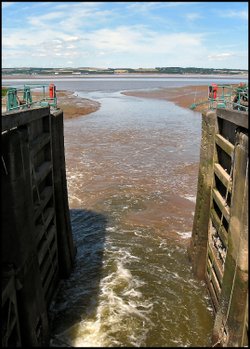
Ferriby Sluice, North Lincolnshire

 She ran to tell her grandmother and when they returned to investigate, the "blockage" was found to be Horace, sitting on the loo with his driftwood limb braced against the door to repel unwelcome boarders! Most people whistle to announce their presence in the outside facilities. Our Horace had his own unique way of keeping intruders at bay!

Full tale here: Captain Pegleg in the loo and all the merry Barrass crew

Ferriby Sluice, South Ferriby, Lincolnshire. Scene of many a launch of our keels onto the Humber


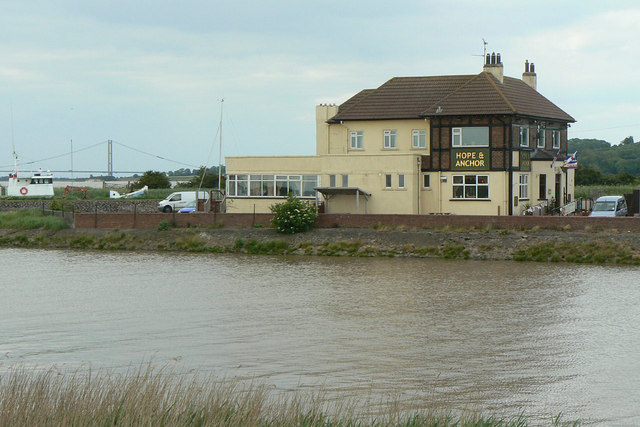
The Hope and Anchor pub at Ferriby Sluice, North Lincolnshire. A welcome sight to the homecoming mariner!
I've had the privilege two or three times in recent years of sailing with other descendants of the keel families among my ancestors, on the last fully operational keel boat under sail, "Comrade." We set sail each time from the very spot pictured in the photo of Horace and his chums.

The good ship 'Comrade', the only Humber keel still working under sail


'Comrade' was restored and crewed by members of the "Humber Keel and Sloop Preservation Society" from instructions and guidance given by retired keelman Fred Schofield, who also came from my ancestral home village of Stainforth. His book 'Humber Keels and Keelmen' is like the ultimate bible of all things keel!


Keelman Fred Schofield's wonderful book


 I've actually been at the tiller of 'Comrade' to help (or hinder?) her crew in the steering of this beautiful ship right under the Humber Bridge! The captain did say that my Barrass ancestors would be turning in their graves. I felt very close to them indeed. Several ancestors drowned while sailing their keels, so it's quite a miracle my efforts didn't ground her! One of my ancestors even managed to shoot himself fatally in the arm while attempting to shoot a crow from the deck!

The Humber Keel and Sloop Preservation Society. Website here: Humber Keel and Sloop Preservation Society website


This year, the 40th Anniversary of the founding of the 'Humber Keel and Sloop Preservation Society', was celebrated by an exhibition at South Ferriby, from where the keel 'Comrade' and her sister ship the sloop 'Amy Howson' now sail regularly to give interested members of the public a taste of how their ancestors lived and sailed on these amazing vessels.

The keel 'Comrade' and the sloop 'Amy Howson' approach the Humber Bridge


It was at this exhibition that my lovely sixth cousin Ann (possibly seventh cousin, that still being a moot point in our genealogy!) saw the fantastic photo of the group of mariners and their families at the top of this blogpost, on display as a slide.


Nothing was known about it, except that the original photo had written on the back that it was taken at  "Ferriby Sluice, 1957". Ann knew about my Horace from my research into my family tree and hers. She had little doubt this must be him. Or some huge coincidence: two men in their sixties with a missing leg, in this small waterways community. She sourced the photo and was generously sent a copy, which her husband Don, a keen amateur photographer, enhanced just a little, to make it even more crisp.

So it came at last into my possession.


If you too have been bitten by the family history bug, you can imagine what a joy it was to gaze at last on the features of my third cousin three times removed!


Who are the people round him? His wife Mary Elizabeth Flora Scott? His children Eva, Frank and Gordon? Other friends, family and locals from among the watermen and women, mariners and sailors in our blood?


I dearly hope someone reading this now or in the future may know much more than I do about this photo, so together we can discover more about our roots and the stories behind the faces. 


Please do get in touch if you recognise anyone or anything here. I would love to hear from you.


Comrade sailing on  the Humber


Friday, 28 May 2010

Captain Pegleg in the loo and all the merry Barrass crew

Photo: Clifton Park, Rotherham, South Yorkshire, UK

Recently, I managed to attend a lunchtime talk at Clifton Park Museum, by a wonderful man called Jim Wilson about "Humber Keels". As friends will know, my Barrass roots go way back on the canals of Yorkshire. Generations of my ancestors were keelmen and women, master mariners, captains, mates, sailmakers, ship's carpenters and just about every other occupation associated with living around ports and inland waterways.It was surreal to hear Jim, who didn't know me from Adam (or Popeye!) as he spoke, talking about my Barrass ancestors by name.

He regaled us with tales of my distant Victorian third cousin three times removed, Pegleg Barrass, christened marginally less comically as Horace in Stainforth near Doncaster in 1889. Horace lost a leg as a young man in WW1, something to do with barbed wire, I believe, and with true Yorkshire Barrass grit, made his own wooden leg from boatbuilding offcuts going spare along the canal. Jim was rather scared of him as a child, as he seemed as exotic as Long John Silver to his young eyes! 

Another relative who was a young lass in Stainforth in the 1950s once told me a tale of trying the door of the outside toilet shared by houses along the canal bank there. She rattled the "sneck" (handle) of the toilet door, but found it wouldn't open more than a crack because, as she thought, some prankster had jammed something against the door to stop folk entering. Seeing the obstruction was an old piece of driftwood, she ran off to tell her granny that someone had put a chair leg or a wheelbarrow in the lav! You're ahead of me, aren't you? Yes, it turned out to be our Pegleg sitting quietly on the loo with his wooden leg propped up against the door to repel boarders and ensure a bit of privacy! I told Jim this tale after his talk and we reminisced about the lives of our keel forebears.

When I got home, I looked at some census returns to see where Jim's Wilson family might fit in with my own canal genes. Sure enough, his granny was one of the Parish family, and my first cousin five times removed, Martha Barrass, born in 1814 married David Parish, a boat hauler along the river. Yes, when a horse wasn't available, or on sections of the canal too narrow to set the sails, the heavy barges were attached to a strap around the chest of a man or woman to be hauled along.

On the 1881 census, in the Old Harbour at Sculcoates in Hull, I found many keels moored together. Jim Wilson's great grandparents, James and Lucy Wilson, were there on board their keel "Kate" (named after one of Jim's great aunts, a little girl on the keel at that time) and, moored just two berths along the quay, one of our keels, the "Thistle". "Thistle"'s captain was my great great gran's brother, Thomas Barrass (born in Stainforth in 1839), and his mate was my great great great granddad, Samuel Barrass (b 1816, Stainforth). Also on board were Tom's wife, Mary Ann nee Brooke from Gainsborough and their three children, the youngest of whom, George went on to die in 1916 in WW1, when he was an acting corporal in the 6th battalion of the East Yorkshire Regiment.

Family history never ceases to be a joy, whether it uncovers funny or tragic stories. I have my share of murderers, bigamists, eccentrics, suicides and adventurers but I think our Pegleg is perhaps one the more memorable to the citizens of Doncaster! Cheers, Horace!


Tuesday, 4 May 2010

"Charlotte's Song" Lyrics (2004)

Over the Humberhead Levels
I see the keels on the cut:
Leeboards are ready for raising,
Onward, now, ready or not

Tides roll on, hell or high water,
Little one, stowed in my deep,
The coamings are fog-draped beyond us
The waterway mumbling of sleep

Pinder and mariner rise up and range,
The peat-cutters wait at the stile;
My grandfather watches the door from the settle,
The nightjar, she weeps all the while

No-one can sift out your shadow, my love,
No-one knows quite where we lay;
Whispers and rumours, half-guessing our story -
My journey to Hull far away:

There in the muck-garths and cobbles,
There in the alley, my child,
Your birthing so precious and brutal and fragile,
Bleak as the sea and more wild!

Now as we a wait for tomorrow,
Your heart beats its future for me:
I leave you the Chase where the lapwing is tumbling home
Over the Lings to be free!


Dedicated with love to my great great grandmother, Charlotte Barrass, keelgirl, wife and mother, and my great grandfather Thomas, who was the child she conceived and bore in Chaffer's Alley, Witham, Hull in May 1857, the year after her grandmother Nancy's suicide. Charlotte died of TB in 1865, a few short weeks after giving birth to a little brother for Thomas, George Bottom, following her marriage to farmer William Bottom in Hatfield Woodhouse. Baby George only survived his mother by one day, and mother and child were buried together on a snowy February day in Hatfield St Laurence churchyard, close to Charlotte's Barrass roots in the bleak Humberhead levels, near to Hatfield Chase and the Lings, where a windmill used to turn its sails in the wind from the seas far beyond.