Showing posts with label Genealogy. Show all posts

Tuesday, 4 July 2017

ALL MY GRANDFATHERS GREAT: 4. The one who was a 'bit of a lad' and a bigamist

James Wallace in his army uniform in the 1880s

Last in this series of blogposts about 'all my grandfathers great', concerns my maternal grandma's father. He was James Wallace, a lucky Jim who was known in our family in hushed tones as a 'bit of a lad', the one who was a saw maker, had an extra tooth in his lower jaw and was a bigamist.

Jim was born to a Sheffield cutler, Charles Wallace b 1824 with distant Scottish roots, who became a professional vocalist, travelling round the northern counties singing in the Music Halls, and his second wife, an Irish lass, Mary Ann Bray who had, I believe, come over to the north of England in the wake of the Irish 'Great Hunger', the mass starvation of the 1840s.

Jim used to tell my grandma and her elder daughter Phyllis, my aunt, how he "went round singing on my father's knee." Jim was born in Hanley, Stoke on Trent, while the family were touring there in 1859. A younger brother, Albert, was born in Bradford the following year, and other siblings were born in Sheffield and Leeds. Censuses and certificates show the itinerant family in other venues such as Halifax, a place that would become especially significant later in Jim's life.

Jim was always a restless soul, having grown up on the road, in and out of places of entertainment. I get the impression his boredom threshold was set very low! As soon as he was old enough, after the deaths of his parents, he joined the Army in the Prince of Wales Own Yorkshire Regiment and served in India from 1880-1892. He used to tell his own children when they were slouching at the dinner table:

"Sit up straight, because I was in the army in India!"

His army records reveal, among other gems, that he spent a lot of time in the military hospital in India with malaria every hot season and with an injury from being knocked out with a cricket ball. Whether intentionally is not revealed! He also had an extra tooth in his lower jaw, something I inherited from him, or rather I have inherited the space where that tooth should be, which dentists have remarked on, mystified.

On one of his furloughs from the army in 1887, he was back in Sheffield to marry Alice Jane Seagrave, my great grandma, by whom he had a daughter, Annie Lilian, known as Lil or Lily, a son James Victor and another daughter, my maternal gran, Elsie, born the year he left the army. Looking back, it becomes evident that once he'd left the army, life at home with a family was a bit tame for 'bit of a lad' Jim.

In a short space of time, he had moved his family in with a local girl, 13 years younger than Jim, who ran a local Sheffield Dining Rooms on the premises where my grandma was born in 1892. This lass was an invalid for much of her short life, with TB, and must have been glad of the extra rent from Jim. They had a child together just five years after my grandma was born, a boy who was a brother adored by my gran and taken in most willingly by Alice Jane after the early death of his mother.

At this stage, rather than living in the same house as landlady and tenants, they were living next door, and Jim was the informant present at his lover's death. The lad's great grandma insisted , rightly, that Jim take his responsibility to his son seriously, not a hard ask given the lad's adorable personality and the fact he was already very much considered part of the family, then and ever after. The mind boggles at the brazen way Jim went about things, though! Oh, to have been a fly on the wall to hear the polite conversation at the breakfast table once my long-suffering 'wouldn't say boo to a goose' great grandma Alice Jane knew what he had been up to for so long behind her back and under her nose and roof.

Jim did various jobs up to his retirement: tool maker, saw maker (his mother was part of the Davenport saw manufacturing dynasty in Sheffield), bicycle maker, invoice clerk, spade and shovel maker. From his children's school records, it seems Jim was not always around. No surprise there! Ever the wanderer with an eye to the main chance, a charmer who inevitably came up smelling of roses, in 1921, when my gran Elsie was holding her eldest newborn child in her arms, her father was on a flying visit, and said as he left:

"Well, Elsie, I'll see you when I come back!"

"IF you come back..." my grandma said wistfully.

She adored him but knew him too well to fall for his patter. She was right that she would never see him again, that he would never again live with her mum. But nobody could have predicted what would happen next, as Jim reached his mid sixties.

Remember Halifax? That's where Jim's father and mother had married back in 1853 when they were travelling vocalists. In 1924, leaving no traces back in Sheffield, Jim, still married to my great grandmother, was in Halifax in his retirement, claiming to be a widower. There, he married another Alice, bigamously, under the name James Maitland Wallace. He used his uncle Henry's name in place of his father Charles's on the illegal certificate, and claimed to be still in his late 50s!

Nobody knows where he dreamed up the name Maitland. Perhaps drawing on his pride in his distant Scottish roots? It kept me off his trail for many a long year! The only clue I could trace is that the minister who officiated at the wedding of Jim's younger son, my great uncle by the family's landlady, which took place in Sheffield that same year, had Maitland as his surname. Who can tell if it wasn't some bizarre joke on Jim's part? In any case, it kept him one step ahead of the law. Meanwhile, my great grandmother Alice Jane went to live with their eldest daughter, only dying in 1933.

His eldest lass Lil took his secret to her grave, and did her level best to save his skin. She buried her mother in the Seagrave family grave in Sheffield General Cemetery as a "widow". Nobody but close family would be any the wiser till I started digging seventy years later!

James, to his credit, faithfully nursed and cared for his second Alice till her death after a long illness in Halifax. During the Second World War his eldest daughter Lil sent my aunt, her niece Phyllis, to check Jim was safe during the blitz. She was the only person alive who had his secret address. My aunt remembered spending the night in the same bed as Alice Mk II in their tiny terraced house that stank of gas. Goodness knows how Jim explained to poor Alice who this lass was who had turned up out of nowhere claiming to be his granddaughter, from the family he dared not speak about for fear of the long arm of the bigamy law!

Towards the end of WW2, in January 1945, Jim turned up unexpectedly at my grandma Elsie's funeral, his youngest daughter who had died unexpectedly at 52 from heart trouble. My aunt clearly remembered the tears in his eyes. Jim himself had angina from the age of 42, but went on to live to the ripe old age of 92. He spent his twilight years with daughter Lil and her family in Cheshire, not far from where his first and only legal spouse, Alice Jane, had also died twenty years previously.

On his 90th birthday, my uncles arranged to fulfil their errant grandfather's ambition of going in an aeroplane at Manchester Ringwood Airport. Irresistible to the end, he always got his way!

Oh what a tangled web we weave, and all that. But those tangled webs are the stuff family history is made of. We genealogical armchair detectives wouldn't have it any other way. Those weavings are the very substance of who we are and where we have come from, what binds us together with so many fascinating silken threads of memory and mitochondria.

Great grandfather Jim in old age, dapper to the end

Monday, 3 July 2017

ALL MY GRANDFATHERS GREAT: 3. The one who was an inventor and went bankrupt

My Great Grandfather, Charles the cabinet maker
The third of my great grandfathers is on my maternal side, my mum's dad's dad.

Charles Mamwell was the eighth of nine children born to Christopher, a cottager (farmer) in the tiny village of Grainthorpe, a couple of miles inland from the bleak coast of Lincolnshire and Mary Townend, a lass from the neighbouring village of Marshchapel. The year was 1839 and the new Queen Victoria had been on the English throne for two years.

Charles's ancestors had lived in Lincolnshire, farmers, builders, fishermen since at least the 1590s. He was apprenticed as a cabinet maker and to better his employment prospects, moved north to the steel city of Sheffield in the West Riding of Yorkshire, at the height of the Industrial Revolution in the early 1860s.

There Charles met and married Elizabeth Oldfield, niece of Sheffield philanthropist and businessman James Howarth, an Edge and Joiner's Tool Manufacturer, her mother's elder brother who had founded the firm Howarth and Sons. Charles must have felt at the top of his game, with premises on Fitzwilliam Street and later a shop on Queen's Road at Heeley.

One of his nephews, his brother William's lad from Grainthorpe, came to Sheffield to learn the cabinet making craft from Charles as his apprentice at the beginning of the 1870s. However, this nephew, William, never became a rival cabinet maker in the city. Instead he wandered the country doing various carpentry jobs, before ending up in Blackpool, on South Beach, where he set himself up as a phrenologist with the tag-line: "Prof W. Manwell (sic); private sessions 1s/6d". Bump-feeling was a popular pseudo-science at the time.

Back in Sheffield, Charles and Elizabeth had three daughters: the eldest a skillful left-handed hosier and draper called Helen and her younger sisters Alice, a midwife and Ada, a cook. Another child, a son called Charles Arthur Oldfield Mamwell died in infancy of convulsions. Charles travelled back to  visit his folks in his native Grainthorpe regularly, and his younger children were baptised in the Parish Church of St Clement's there in the village.

Helen was born with a facial birthmark which, by the estimation of those times, disfigured her. Wanting the best for Helen, Charles paid for treatment from what we might call a 'quack' doctor, which must have cost him very dearly. Not long afterwards, he declared bankruptcy. The sad saga of his creditors and debts I discovered in the pages of the Sheffield newspapers, in stark contrast to the joyful announcements of his marriage to Elizabeth only a few years before.

This 'treatment' left Helen so damaged that she was compelled to wear a veil over the affected side of her face for the rest of her short life. Gradually, her face was eaten away as the mole grew cancerous and she eventually died at the age of 47, after many years of stoical suffering while carrying on her drapery business at a shop in Broomhall, of carcinoma of the larynx. Charles did not survive to see the final years of Helen' life, perhaps mercifully, as he never forgave himself for his well-intentioned intervention.

Two years after the death of their infant son, Charles' first wife Elizabeth also died at the age of 35. You can trace the course of Charles' grief by looking at his writing in the family Bible, where he recorded all the births, deaths and marriages of his family in the middle pages under tissue paper inserts. In the days before Elizabeth died, his looping copperplate script is a thing of beauty. Later, the letters crowd and sag, reflecting his grief and despondency as his life spiralled down from those first hopes and dreams.

Alongside his cabinet making, Charles was an inventor. He invented a hinge for a school desk. It never rains but it pours. When he showed his design to a man who promised he would take it to patent it for Charles, this same charlatan stole the design and passed it off as his own. I inherited the article in a newspaper cut out and saved by my great grandfather, praising this other man for "his" ingenious invention. One more nail in the coffin of Charles's high hopes of success and security for himself and his family. I also have his prototype model of the hinge, still in the original buff envelope in which he kept it ready to make his family's fortune, and an oak chest with his business plate lovingly hammered into the dovetailed wooden joinery.

Elizabeth Thompson Mamwell, b 1848, my great grandma and Charles' second wife


Charles hired another Elizabeth, Elizabeth Thompson, a cobbler's daughter, to help look after his young girls when he was widowed. My great grandmother was a sunny, capable, humorous lass, and they fell in love and married the following year. They went on to have another two daughters and, finally, a surviving son, my maternal grandfather, Chris, born in Tipton Street, Wincobank in 1889.

They moved further out into the Sheffield suburbs, to Chesterfield Road, Norton Within, where, at the age of 63, Charles died of apoplexy, a broken man. He is buried with Helen and my great grandma in the cemetery at Norton Lees, overlooking the gorgeous Peak District that was the backdrop to his hopes and his hardships.

Sunday, 2 July 2017

ALL MY GRANDFATHERS GREAT: 2. The one who spelled his name wrongly and whose bones went to chalk


The second tale of my grandfathers great kicks off a little further south, in the Erewash Valley in the English Midlands, on the border between Derbyshire and Nottinghamshire.

Last blog, you met my ancestor Thomas Barrass. My other paternal Great Grandfather was James Ellis, born in Awsworth in Nottinghamshire in 1874, the eldest boy in a family of eight siblings in a mining family in a mining community.

I have no photos of James, but I'm told he was tall and spare, and according to my dad's cousin, I am the spitting image of him, which I take as more of a compliment than she perhaps meant it to be!

The nearest I can come to knowing what he looked like, short of looking in the mirror and cutting my hair in a short back and sides from the start of the last century, are these photos of James's younger brother William Henry, whose lovely granddaughter I went to school with, still my dear friend, who lent me this picture:

William Henry Ellis, my great granduncle b 1884 in WW1
James's surname, "Ellis" was wrongly written as "Ellies" on his parents' wedding certificate, and on James's own birth certificate. His siblings had no scruples about shruggling off this error, but it seems James was more wary. On the 1911 census, when James was sharing a house with his younger brother William's family, William fills in his bit of the return as "Ellis" but no! Great Granddad James dutifully writes "Ellies". He doesn't want the men from the ministry making trouble, now, does he?

James worked as a miner down the pits of the Nottinghamshire Coalfield and married a local lass, from nearby Ilkeston, Mary Ann 'Big Polly' Stenson. The Stensons had given their name to Stenson's Lock on the Erewash Canal, as many of Polly's ancestors had worked on the canal as wharfingers and lock keepers. They had two children, my paternal grandma Mary Elizabeth 'Little Polly' and her younger brother Lambert. Sadly, Lambert died of tubercular meningitis and exhaustion when he was just six years old. James was present at the death in Nottingham General Hospital. There were no more children, and I grew up imagining my grandma was an only child, like me.

When the Barnsley coal seam was discovered in the later years of the nineteenth century, new pits began opening on the South Yorkshire coalfield. Some of James's family, including some of his brothers and inlaws, moved north to work in these new areas.  James and his two Pollys, big and little, left the scene of the loss of their beloved Lambert and settled close to where his relatives were already telling stories of Yorkshire hospitality, in the village of Goldthorpe, nestled in South Yorkshire's Dearne Valley.

James worked as a dataller (a worker hired or paid by the day) at Hickleton Main colliery until crippling rheumatoid arthritis confined him to a water bed upstairs in their cramped terraced house. He never left that bed again. As my gran always told me:

"His bones went to chalk" 

which I learned as a fact till his death certificate told me the full truth many years later. Cerebral hemorrhage, arteriosclerosis and his long-term rheumatoid arthritis ended James' life at just 56 years old.

He is buried in Bolton-on-Dearne cemetery with his Polly and close to other members of the family. From the Erewash Valley to the Dearne Valley. My grandma was always proud of her Ilkeston roots, and so am I. Going back there once I had unravelled the history was one of the most moving of my genealogical adventures. I can't explain how much it felt like home from home.

One bonus discovery I made along the journey to discover my great grandfather's story: James's elder sister Charlotte was aunt by marriage to the successful and popular Ilkeston-born jockey, Elijah 'The Whippet' Wheatley, who won the 1913 St Leger on Night Hawk, and married famous music hall star Marie Lloyd's sister Maud. We genealogists have to grab our claims to fame with both hands, whenever we find them, you know!

Mary Elizabeth "Little Polly" Barrass, nee Ellis, my paternal grandmother, only surviving child of James Ellis and Mary Ann "Big Polly" Stenson Ellis 

Saturday, 1 July 2017

ALL MY GRANDFATHERS GREAT: 1. The one who worked with horses, dreamed of sheep and kept secrets

Yours truly at Huggin Carr, Hatfield Woodhouse near Doncaster in 2003, where my great grandfather Thomas Barrass worked as a farm lad in 1871 aged 14


Family history is so giddily glorious! (At least, it is to those of us who have ever been bitten by the genealogy bug!)

Years of trawling round gusty graveyards, scrutinising old photos, traipsing round records offices, perusing births, marriages, deaths, going cross-eyed over newspaper cuttings, chasing up family rumours, and I feel like I know many of my kin from a bygone age.

Can't text them. Can't email them. Can't Skype them.

But I feel like I know many of my ancestors better than I know some of my living friends and family! They run through my dreams. They inhabit my heart. They echo through my writing.

My four great grandfathers are right up there, jostling for attention, to be known and named and nattered about, long after they died in the days before I was born. Like the best of friends, I'd like to introduce them to you. Grab a cuppa - incoming series of four!

First there's Thomas, the one who worked on farms with horses and narrowly avoided causing me to be a Bottom. Thomas Barrass was a man of many secrets.

I have no photos of Thomas. No photographs of my dad's side of the ancestors survived the bonfires kindled by one over-zealous married-in relation who decided, after my grandfather's death, that tidy drawers and clean breaks were preferable to pictures of your husband's unknown Victorian ancestors grinning back at you in sepia.

The family rarely spoke about Thomas. He was born in 1857, in a run-down area of Hull near the docks called Chaffer's Alley, long since swept away by slum reforms. This was where his mother Charlotte's ancestors had been mariners and keelmen, shuttling between the port and the canals and waterways they called home for generations.

Thomas was born under a double shadow. No father was named on his birth certificate. The shame that went with that in the past is hard for us to grasp today. Only a year earlier, his mother had been in the farmhouse when her grandmother, a Yorkshire farmer's wife and daughter of a seafaring man, slit her own throat with a penknife while suffering from 'melancholy' on a cold winter night while lying in bed next to her husband of half a century. That tragedy split and scattered Thomas's family.

His mother hastily married a kind man who seems more than likely to have been Thomas's father, a yeast and bacon dealer, a cordwainer's son from a tiny village near Doncaster, as soon as she was free from the responsibility of caring for her devastated grandfather, after whom Thomas was named. They married at Thorne Register Office in October 1861, a matter of weeks after Charlotte's grandfather passed away. Had the marriage taken place a few years earlier, Thomas's descendants, myself included, would not have inherited his mother's surname, Barrass, but that of his putative father, Bottom. I'm truly thankful for small mercies!

When he was just seven, Thomas's mum died from galloping tuberculosis just before her thirtieth birthday. Little Thomas was like the cuckoo in the nest when his widowed father wed again, going on to have many more children who bore his own blushfully preposterous surname. (Sorry, Bottoms up!)

Thomas worked as a young lad on local farms. He had a special affinity for horses. He had less affinity for writing, as his childlike spidery signature in the marriage register shows. He made up a name for his father (his own name) and put 'tailor' as his father's profession, grasping at the idea, perhaps, because his mother was a seamstress and dressmaker.

He soon felt the wanderlust that ran in his veins, but instead of sailcloth and tide, he followed the call of the earth from his great grandfather's farming blood. Thomas moved away from the flat farmland around Doncaster to the hills and valleys near Barnsley, first to Bolton-on-Dearne, where he married a lass whose relatives were, in contrast to Thomas, chatty, jokey, confident, open.

Thomas and Eliza had ten children, including twins and my paternal granddad. How they all subsisted in a tiny tied farm cottage at the bizarrely-named 'Rockley Bottom' near what is now Worsborough Country Park, is an enduring mystery. In fact, Eliza didn't survive for long. At forty-seven, after another short move to Upper Hoyland, cerebral meningitis snatched her from Thomas's side. This new blow left him struggling to bring up his large family alone. The eldest girl, Blanche, became a mother figure to her younger siblings.

Luke and John (Jack), twin sons of Thomas b 1893


Newly bereaved, Thomas decided, along with many other Yorkshiremen of the day, to seek his fortune at the other side of the world. The Patagonian sheep farming boom was still a draw for struggling agricultural labourers of the Old World. Thomas is listed in the ship's manifest as "Thos Barries", shepherd, travelling steerage to Punta Arenas (as his son Joseph told his own son Joe) on 27th September 1906 from Liverpool on the "Oriana" with many other farmers and shepherds. Eliza had died in April the year before.

It seems an unlikely move for an unambitious soul like Thomas, but life had already thrown all it could to scupper his happiness - suicide, illegitimacy, rejection, widowhood, poverty. He had very little left to lose. So he sailed to Chile's Punta Arenas, bound for Argentina in the early years of the new century to seek his fortune on the sheep farms, opportunities offered as an incentive to emigrate in the local newspapers at the time. But he soon returned to South Yorkshire. The best of the boom was long past. It wasn't the first boat Thomas had missed.

In his declining years, Thomas seems to have been a regular guest at the seasonal celebrations of his children's families, particularly his twin sons' families in Ackworth, a taciturn ghost at the feast, giving little away, of words or goods.

I learned from a cousin of my dad's, one of the twins' children, how Thomas was a man of very few words. No wonder. He had so many secrets to keep, not least suicide and bastardy, which in those days attracted discrimination and judgment from society.

His wife Eliza's family, the Wrights, used to tease Thomas, get him drunk, mock him, emphasising his otherness in their eyes. Dad's cousin, a child in the 1920s, remembers Thomas jingling half a crown in his pocket for ages, a coin his grandchildren thought he was going to give them as a treat before he left for his own cottage. As he left, having eaten and lodged for free over Christmas, he would grudgingly give them just a few pennies instead. They saw only a miserly freeloading old man. As a more distant descendant with the fuller picture laid out in the branches of my family tree, I have the luxury of judging him less harshly.

By 1911, Thomas was living with his son, my granddad, in Goldthorpe, in retirement from his labouring, but he did not stay in one place for long. He moved to his last home on Longfields Crescent in Hoyland, near to where his youngest child, Grace, lived with her husband and children in a caravan, not far from where Eliza had died. Perhaps our love of compact living spaces, be it caravan, cottage or cabin, stems from Thomas's roots living aboard the Humber keels that were home to many generations of the Barrass family. His ancestors founded the keel community that grew up around Stainforth on his Barrass side, and were Thorne mariners on his Pattrick side. Blood and water - canal water, that is - are equally thick in our family!

Thomas died in the building used as the Barnsley Workhouse on Gawber Road, that later became St Helen's Hospital, now part of Barnsley District General Hospital. It was the summer of 1928, and Thomas was 71, suffering from the cardiovascular troubles common in his side of the family. His cause of death was given as valvular disease of the heart.

Many years ago, as I began to dig into our family history, I discovered how deeply hidden Thomas's roots lay. When I asked him the routine starter question about his grandparents' names, my father could only say, frowning in puzzlement,

"I have an idea they were William and Mary..."

That's all Thomas was for many years. Eliza too. Forgotten. Misunderstood. Question marks in the dim distance of time. The ancestors before them, too, were obscured by fogged opaque glass. Tragedy had sent them scuttling for cover, for anonymity, even to their own.

That's why I think telling our ancestors' stories is so healing and so important.

One great grandfather down.

Three to go.

Join me here on 'Pinwheels and Rainbows' tomorrow for the next.

Exploring my waterways roots on the West Cut Bank in Stainforth, near Doncaster, where Thomas's mother Charlotte and generations before and after her were born around the Stainforth & Keadby Canal


Tuesday, 10 February 2015

Goatsucker Harvest: Naming names

Seeing a SEAGRAVE grave ( my great great granduncle Solomon's) in Gleadless, Sheffield

It's no secret that family history is to me what sitting in his writing shed was to Roald Dahl - inspirational!

Most characters in "Goatsucker Harvest" I christened with first names and surnames that appear somewhere up my own knotty and gnarly family tree.

A beloved sixth cousin of mine - does anybody but a genealogy buff actually KNOW any of their sixth cousins? - was delighted when she downloaded 'Goatsucker Harvest' onto her Kindle, to discover I'd used the name of her own great grandmother (a distant limb among the seventeen thousand plus individuals on my tree), namely Kerenhappuch. Our real live Kerenhappuch was actually a cockle picker, born in 1843. 

I've no idea what Kerenhappuchs in the real world were called for short as a nickname. I only know how many crazy misspellings officials managed - 'Karen Dappack' being my particular favourite from the 1861 census! The name's biblical, one of Job's daughters in the Old Testament, Keren-Happuch, 'child of beauty' or, less meaningful to us moderns, 'horn of antimony'! 

In 'Goatsucker Harvest', I take the liberty of calling Thirza's great grandmother "Happy" for short. Keren-"Happy"-Happuch's only mentioned when Kezzie (named after Kezia, a distant cousin three times removed, one of my paternal gran's Ilkeston forebears) remembers wearing her mother Happy's corset on her wedding day. Something borrowed, like my ancestor's amazing names!

The Holberry family at the heart of the story are named after my 3x great grandmother Sarah Holberry, a Victorian farmer's wife in Hatfield near Doncaster, the area where the novel's set. Sarah's cousin was the Sheffield Chartist hero Samuel Holberry, who died in York Jail, now the Castle Museum, in 1842 on the treadmill, the same invention attributed to Sir William Cubitt, and mentioned with regret by him as the plot unrolls for his fictional incarnation. 

Similarly, the Kitson clan. My 5x great grandmother Diana "Dinah" Kitson, herself a woman of the Yorkshire waterways, has her name used twice in the book, for the family at Kitson's Windmill and as Thirza's mother's Christian name. Thirza herself is called after several of my own distant cousins.

Darnell borrowed his moniker from the surname of my 4x great grandmother, Dinah Darnell and her Darnell kin from the Lincolnshire wolds and coast. I took especial joy in using this name for the Machiavellian inventor, as "Darnel" is also an old word for "tares" or "weeds" that grow among the wheat, symbolic of the troublesome growth not always fully rooted out until harvest time.

The shadowy "Dr Stenson Seagrave" is called after two of my great grandmothers, Polly Stenson & Alice Seagrave. Alice was niece of the Sheffield seedsman Solomon Seagrave, after whose Victorian plant nurseries several streets in Sheffield are still named (see photo).

Bram takes his unusual name from the East Yorkshire Beharrells who were the kinsmen and women of Sarah Ann Beharrell, married in 1871 to a great great granduncle of mine, moving from Hull to live in Rotherham, not far from the canal.

Even "Thistle" is named after the keel on which my 3x great granddad and his son were master and mate on the night of the 1881 census, in Albert Dock in Hull (watermen who inspired me to make Jack Holberry and his family spring to life in 'Goatsucker Harvest.')

So it goes, with nearly every name you read in the 'Goatsucker Harvest' story. Hidden thankful tributes to the ones gone before who inspire me.

Chester, Charlesworth, Brunyee, Hanson, Jacques, Canner, Wraith, Poskitt, Salkeld, Foljambe and the rest. Echoes of the genes that still sing in my blood; family, kinsfolk and their neighbours along the canals and moors of the West Riding of Yorkshire, the Isle of Axholme and beyond, down the centuries.

They aren't the strangest or the silliest names on my tree. Not by far! That honour would perhaps belong to Garnish Broadbent, Kelita Hall (both male) or poor old Original Bottom. But that's for another story!


Tuesday, 3 January 2012

This Melancholy Act: Suicide and Secrecy in Victorian Yorkshire Part 2

G. F. Watts - Found Drowned - Oil on Canvas ca 1848-50

I wrote last September here about the ripple effects through our family history of the suicide of my great great great great grandmother Nancy Turner in January 1856.

Friends who read this will know how much I want to understand more of what happened. My hope is to track down the actual inquest one day.

Blogging and social networking can bring such helpful blessings! One person who came across my blogpost was my fourth cousin once removed, David. David is also descended from Nancy and Thomas, through their youngest child, Charlotte, sister of my 3x great grandmother Hannah. We "met" through our mutual interest in our shared ancestry but had lost touch since I changed laptops!

He got in touch again, much to my delight, when he guessed I was the author of the post about the tragedy. He was kind enough to point me in the direction of the British Newspaper Archive. This resource is searchable for free online, and if you find a newspaper cutting you want to see in detail or to download, there are various levels of subscription, starting at a 2-Day Package of 500 credits valid for 2 days currently costing £6.95.

From the BNA, two issues of the Yorkshire Gazette reveal a little more of our ancestors' story. The first mention of the tragedy appeared on page 10 of the Gazette published on Saturday 26th January 1856. This was a shock in itself. I knew Nancy had died the following day, Sunday 27th, according to her death certificate, issued on March 20th after what we have to conclude was a lengthy inquest. So why was the incident being mentioned before it took place?

The truth is even worse than imagined. Nancy did not die quickly, but attempted to cut her throat with a penknife the previous Monday and was still alive, apparently recovering when the Gazette went to press at the weekend. More upsetting still, the paper reveals she was in bed with Thomas at the time of her attempted suicide. What he and the rest of our family living in the Barlby farmhouse at the time must have gone through, is hard to contemplate:

-BARLBY, NEAR SELBY.--ATTEMPTED SUICIDE.
--On Monday last, the wife of Mr Thos. Turner, of
Barlby, farmer, attempted to destroy herself by cutting
her throat with a pen-knife. She was in bed at the time
with her husband, and he shortly afterwards, from the
noise he heard, found out what had been done. Medical
aid was shortly procured, and she is now in a fair way of
recovery. The unfortunate woman has been in a
desponding state for some time, which was no doubt the
cause of this melancholy act.


Without the full inquest, or some further insight into Nancy's state of mind, we can still only speculate what triggered the act of despair. We can't know if she was suffering from some form of depression we might recognise as a mental health condition today, or whether her final heartbreaking decision was triggered by events that she couldn't bear any longer, such as the emigration and death of several of her close relations including children and grandchildren. But we can glimpse the devastation and grief, even stigma the family had to face then and in the years ahead.

Sadly the Yorkshire Gazette's prognosis for Nancy's recovery was premature and flawed. She died the next day, after living on for almost a week in that state of utter agony and internal torture. The next issue of the Gazette on Saturday 2nd February carried her obituary on page 3:

On Sunday, the 27th ult.,...aged 66, Nancy, wife of Mr Thomas Turner,
of Barlby, farmer. In our last week's paper we stated that
she cut her throat with a penknife on the 21st ult.

R.I.P Nancy. Your blood runs through my veins, and I feel privileged to trace your story and share your sadness. I hope you have now found the peace you could not enjoy in this world. You will never be forgotten.

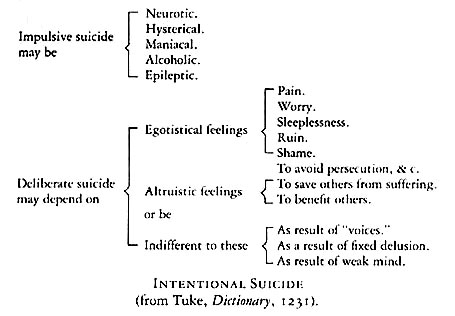
A Victorian chart analysing the causes of suicide: Nancy was deemed "Insane in mind" instead of the verdict "felo-de-se", deliberate, "intentional" self murder, which was still considered a crime in 1856. You were a criminal, by law, if you failed and insane if you succeeded (source: Victorian Web)
Thankfully, unlike many who were not permitted to be buried in "consecrated ground," I finally found Nancy's grave in the churchyard at Barlby, where, in the sad years that followed the "melancholy act," she was joined by her daughter Charlotte Vollans who died just after her 38th birthday in 1858 and Nancy's widower Thomas, who died in September 1861 and whose body was transported from his farm in Hatfield Woodhouse to lie beside Nancy near the home they once shared.


Sacred
To the memory of
Nancy the beloved wife of
Thomas Turner of Barlby farmer
Who died January the 27th 1856
Aged 66 years
Also Charlotte Vol(l)ans daughter
Of the above named Nancy and 
Thomas Turner who departed this
Life June the 15th 1858
Aged 38 years
Also the above named
Thomas Turner
Who departed this life
September 6th 1861
Aged 77 years

Wednesday, 30 November 2011

Ball-pein hammers and scream alarms: the shadow of the Ripper

Guess you know by now I'm a mad keen genealogist and family historian. Well, a few days ago I was watching that new programme on UK Freeview channel "Yesterday" called "Find My Past". Using the genealogy site of the same name, the show traces back the ancestry of three people before bringing them together to show how their ancestors' lives dovetailed in some famous historical event, such as the Mutiny on the Bounty or the sinking of the Titanic.

In this week's episode, two of my interests came together: family history and real crime, as the events that brought the three subjects together were the murders attributed to Jack the Ripper. The three were descended from a journalist who wrote about the case in London in 1888, a policeman who was the last person, apart from the killer, to see fourth canonical victim Catherine Eddowes alive, and Catherine Eddowes herself.

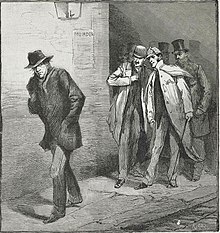
Press image of what Jack the Ripper might look like from 1888


I watched with great interest learning more about these familiar topics. Much of the end of the programme was lost, however, when, with typical foot in mouth brain-foggery, I managed to comment to general hilarity:

"If that policeman hadn't let her out of the cells that night, she'd still be alive today!"

#facepalm#

Another real crime programme on the Internet, about our own Yorkshire Ripper, took me back to the late 1970s and early 80s while Peter Sutcliffe was still very much at large. His crimes spanned the era of my teenage years and young adulthood. Towards the end of his criminal career, in 1980, I had just moved away from my South Yorkshire home to attend Leicester University.

It brought back to me the sense of unease we felt crossing nearby Victoria Park to get to campus from the halls of residence in Oadby. I went home to Yorkshire by train most weekends, as my father was ill. The grip of fear stretched much further than the North, as it was believed the Ripper might move about via the motorway network to commit murders further afield. As far afield, we believed, as the Midlands.

Victoria Park, Leicester

I was in the University Choral Society, so couldn't always abide by the commonsense advice never to walk alone there after dark. Rehearsals were on Monday evenings at 7.30pm if I remember rightly. There were shadowy trees and deserted walkways between darkened buildings after lecture hours to be hurried between on those long autumn and winter evenings. My 19th birthday fell in the first few weeks of the autumn term of 1980.  If a friend missed a practice, you were often on your own.

All this reminded me of two things above all that we young women learned about during the time before the Yorkshire Ripper was caught and convicted of 13 murders  in 1981. Two things we'd probably never had heard of if it hadn't been for the terror his crimes instilled into women all over the country.

First was the "Ball-Pein Hammer". I don't think I can ever think of that tool in any context but as a weapon of choice of the Ripper! Also apparently known as a "ball-peen hammer" - for peening, what else? A machinist's specialist hammer for metal working.  My dad had one in his toolbox, but it was just a common-or-garden hammer to us before the coverage of the Yorkshire Ripper's reign of terror!


Secondly, there was the "scream-alarm". Back in those days, this was a slim cylindrical tin of compressed gas, like an aerosol can. You pressed it to release a shrill, deafening screech, useful, I suppose, if you weren't in a position to scream yourself when under attack. They were made glamorous and sleek enough to fit in your handbag or pocket. Aka a "screech-alarm" or "purse alarm". They came with a warning not to discharge it close to your own or any other innocent person's ear, for fear of causing a burst eardrum!

Modern scream alarm - mine back then was metallic gold


I recall there was always a temptation to let out tiny almost imperceptible coughs from the device as you made your way along through the darkness of the night, just to make sure it would be fit for purpose if needed urgently. So after a few months, most of the internal gas had dispersed and you needed a replacement!

Oh the memories. Nothing for us to compare with the way the lives of his victims' families were torn apart forever. But I can still feel the countrywide sigh of relief when Peter Sutcliffe was finally arrested in my native Sheffield on 2nd of January 1981. Choir practices didn't seem such a risk, that Spring term! Though we kept the scream alarms about our persons for some time to come, and never quite looked at ball-pein hammers in the same way ever again!

Poster showing the handwriting and hoax  recording sent to police at the time of the Yorkshire Ripper murders

Tuesday, 27 September 2011

Walking into the Silence: Suicide and Secrecy in Victorian Yorkshire Part 1


This image from the 1851 census is a snapshot frozen in time.


It shows the occupants of a farm next to the Manor House in the little village of Barlby in Yorkshire, England. The head of household and his wife are my 5x great grandparents, Thomas Turner Snr,  farmer of 166 acres and Nancy, nee Pattrick, a waterman's youngest daughter from Thorne near Doncaster.


Also at the farm that night are Joseph Vollans, who studied farming and husbandry with Thomas and married his youngest daughter Charlotte. Their children are Mary Ann, Thomas and baby Elizabeth, not yet a year old.

This splendid photo shows Joseph in old age, long after the tragic events that tore the family apart just five years after this census was taken, which he almost certainly witnessed.

Joseph Vollans 1822-1901 my great great great granduncle
The other occupants include Charlotte Barrass, my great great grandma aged 15. Her mother, Hannah, was the Turner's fourth child and had married my 3x great grandfather, keelman Samuel Barrass. Life on the keel and waterways affected Hannah's fragile lungs and she died aged just 28 on Christmas Eve 1843, when Charlotte was just 7 and her two brothers even younger. While the boys could survive onboard the boat, Charlotte came to live on her grandparents' farm instead.

The census also shows local born farm servants George Baxter and John Wilson and the house servant, an Irish lass called Mary Wolder.

Next door, Thomas Turner Jr is farming alongside his father. The eldest son William and his wife Helen were farming back in Hatfield Woodhouse near Doncaster, looking after his father's other property. The family had moved north from Hatfield to Barlby when Thomas and Nancy inherited some money around 1829. Most of the household would be forced to return there when tragedy overtook them.

Thomas Jr's wife Mary Ann, nee Sampson, was a sloop owner's daughter from Hull. Her younger sister Charlotte, also living with them on census night, would later marry her brother in law when Mary Ann died young in 1853. Thomas and Mary Ann's children, George, Charlotte, William and Thomas complete the happy family circle gathered round the table in the farmhouse kitchen.

Modern map of Barlby, often flooded by the River Ouse
That veneer of happiness and prosperity wasn't to last.

My Dad could not even remember his grandparents' names. There seemed to have been a split in time somewhere. Roots had been rubbed out, stories left untold. Even Dad's oldest living cousins seemed only to have vague memories of my great grandfather Thomas Barrass, a farmer, Charlotte's illegitimate son, born in 1857.

He had never told his children anything of his past. At first I wondered why this settled domestic idyll was something he would be reluctant to recount. Even his own birth, 'out of wedlock' as the saying went, before his parents' marriage, didn't seem fully to account for the information vacuum.

Brambles and briars in a corner of Barlby churchyard

On a bleak midwinter Sunday, 27th January 1856, Nancy, aged 66 took a blade and slit her throat.

When I first set eyes on her death certificate, expecting to see she had died quietly in her bed, a shock wave reverberated through every cell of my body. Slowly, as I pieced the truth together, everything began to fall into place.

Since that awful day, the family began to fall apart. They seem to have spent generations moving away from the horror of Nancy's choice and burying the past under layers of silence, like ripples moving out from a deadly stone dropped without warning.


No inquest exists. I still hope one day to uncover some account in a newspaper from the time.

Chillingly, the death certificate was not issued until two months later, in late March. Suicide was a crime and shrouded in shame and superstition back then.

Were widower Thomas and the family under suspicion? Was she found right away? How, where and when was she buried? She was deemed to be "insane in mind". That was the conclusion for almost every suicide. To take your own life was thought to indicate a want of all reason.


No grave exists. Suicides could not be buried in consecrated ground. Back in history, superstition and fear would have them buried at a crossroads with a stake through their heart to prevent the troubled soul's return. The family had to carry this with them all the days of their lives. No wonder they left the village and the pitying, questioning eyes of their neighbours.

All Saints Church at Barlby - but where is Nancy buried?
Joseph Vollans' wife Charlotte died shortly afterwards after months of disabling diarrhoea. One of their children ended his days as a young man in Rotherham Workhouse, labelled an imbecile. Other grandchildren emigrated. Those who were left tried to forget and move on as the silence that I inherited deepened with the years.

I've returned to Barlby in recent years and left a circle of white Yorkshire roses around a stone font in the churchyard there. It was my way of trying to show how our family's love and my celebration of Nancy's place in my genes and genealogy is precious and still means the world to me. I think our backs had been turned in shock and grief for a century long enough.


A postscript to this is the strangest thing that has ever happened to me in all the course of tracing my roots. I was invited to go with a local Women's group to Laughton-en-le-Morthen church one summer evening. There was to be talk about the church architecture, all flying buttresses and Green Men. I had no connection to Laughton, so I thought. But I took my digital camera. Light was failing when we arrived. On a whim, the only grave I snapped belonged to Matthew Pearson, of Selby, born in 1784. I took it solely because I knew Selby was close to Barlby where the Turners farmed, and because Matthew Pearson had been born around the same year as Thomas Turner. 

Grave of Matthew Pearson of Selby, the Coroner who attended after Nancy's suicide, unbeknown to me when I took this photo miles away at Laughton-en-le-Morthen near Rotherham
I thought no more of it. Until a month or so later, when I opened the envelope from the General Record Office containing Nancy's death certificate. I had already been searching for it for years with no luck.


After the shock of the cause of death, the name of the Coroner who investigated the tragedy was what struck me most deeply. It was this very Matthew Pearson, the Selby coroner, whose grave I had captured on film for no reason I could ever have explained till then.


Rest in peace, Nancy. The choices you made, your marriage, your children, even the last sad decision, have helped shape my own story. If I could turn back the clock and the calendar, run back into history, perhaps I would gently try to tell you that tomorrow is another day and help you hope in your own happiness. Tell you it would all turn out right in the end. Perhaps as I left you, I'd whisper in the ears of the rest of the family, to please, please, hide all the knives and razors. But I know and believe you're at peace and your agony long past and healed by love and forgiveness.


You and yours will never be forgotten.

Extracts from my 5x great grandfather Thomas Turner's will:


I respectfully request that my landlords will permit my said son Thomas Turner to continue to occupy the farm which I now rent and occupy of them situate at Barlby aforesaid or in that immediate neighbourhood.

I charge all my real estate situate at Thorne in the said county of York with the payment of the annual sum of five pounds to my granddaughter Charlotte Barrass during her life and I direct that the same shall be paid to her quarterly, the first quarterly payment to be made at the expiration of three months after my decease and I also give and bequeath unto my said granddaughter Charlotte Barrass the whole of my household furniture plate linen and china which may be in my house at Woodhouse at the time of my death for her own absolute use and benefit.

I give and bequeath unto my said son Thomas Turner the whole of my farming stock, implements in Husbandry and valuation in upon and about the said farm which I now occupy at Barlby aforesaid, for his own absolute use and benefit subject nevertheless to the payment of the legacy or sum of one hundred and fifty pounds to my son William Turner which I direct shall be paid by my son Thomas Turner out of my personal estate hereinbefore devised to him and which I direct shall be paid to my said son William Turner within six months after my decease.

Marriage certificate of Thomas & Nancy's youngest daughter Charlotte to Joseph Vollans

...and to my five grandchildren the children of my late daughter Charlotte the wife of Joseph Vollans the legacy or sum of fifty pounds each and I direct that in case any of the said legatees shall happen to die before they shall become entitled to the bequests hereinbefore made to them having any child or children then I declare it to be my will and mind that the child or children of any of the said legatees so dying as aforesaid shall take the share or shares of its parent so dying in equal shares and proportions on their severally attaining the age of twenty one years and I direct that in case any of my said legatees or any of the children of the said legatees so dying as aforesaid shall not have attained their said age of twenty one years at the time the bequest hereinbefore made shall become payable to them.

Thomas Turner's death certificate. The witness was a relative of his daughter Elizabeth, who had married George Chester, a village butcher in Finningley, but predeceased her parents. I cannot find Thomas's grave, either, and wonder if he chose to be buried wherever Nancy was secretly laid to rest?

Tuesday, 23 August 2011

There is a heavy sea astern! Song for a drowned ancestor


No grave marker for my cousin three times removed.


His death certificate gives his place of death as "170 miles NE x ENE of Spurn". Miles out at sea, far beyond where Spurn Point drizzles its thin finger into the wild North Sea off the Yorkshire Coast.

The date was etched on his family's memory.

6th February 1897. The day when a freak wave, attacking like a sea-monster from behind, stopped our George ever coming home to them from the fishing grounds.


His full name was George William Barrass. He was eldest child of my great great grandmother Charlotte's middle brother Samuel, who was a keelman like most of his kin before and after him.

Hull docks, on the North Sea coast of eastern Yorkshire at the mouth of the River Humber


Samuel married George's mother Clara Clark, in 1861. She was a Lincolnshire lass, born near the famous landmark that dominates those flat acres, Boston Stump, at a tiny place called North Forty Foot Bank. Their family of six sons grew up on the sailing keels and around the docks in the port of Kingston-upon-Hull, at the sea end of the Humberhead Levels in bleak and beautiful East Yorkshire.

Boston Stump in Lincolnshire, the nearest town to where George Barrass' mother Clara Clark was born in 1839


The boys in order were:

George William (b 1864) the subject of this blog post, had to step up and look out for his younger brothers when, aged just 42, their father died of TB, and their mother, seeking solace in the bottle perhaps, as she was forced away from life on the ships to the fate of a poor charwoman, died of cirrhosis of the liver five years later aged 45.


Clark (b1867) named for his mother's maiden name, a lighterman on the Humber


Arthur (b 1870), who was already with his younger brother Alfred in the Seaman's Orphanage in Hull after his father's death, indicating Clara could not care for the older boys and could only look after the two youngest


Alfred (b 1872), a seaman; his army records from WW1 show he had brown eyes and was 5 feet 4 inches tall. He had a scar from an operation on a right scrotal hernia and like his brother Arthur, suffered from rheumatism and debility caused by exposure. He had a catalogue of misdemeanors during military service, including absence, fighting on guard mounting parade, using obscene language to an N.C.O., creating a disturbance in the barrack room at 10.10pm and disobeying an order, drunkenness, found in women's quarters contrary to standing orders and being absent from duty again. Then more drunkenness, not paying the proper compliment to a superior officer and insolence to the Company Sergeant Major. Never a dull moment with our Alfie! His character is still listed as "Good"!


Robert Sunter (b 1873) called after his maternal grandfather, a Lincolnshire shepherd. As his father couldn't spell, no doubt the Hull registrar of births couldn't make sense of the name "Sumpter" and Robert's middle name is the nearest approximation to the sound the clerk could arrive at from proud father Sam's instructions!


Samuel (b 1876), the baby of the family, taken under the wing of his eldest brother to be shown the ropes at sea. His life ended suddenly aged 31 when he accidentally fell from a waggonette in Hull and died the following day from fracture of the skull, laceration of the brain and haemorrhage. This makes his part in the tragic tale of his eldest brother George all the more poignant.


When George and Samuel signed on to be part of the five man crew on the fishing smack "Amy Isabel" and set sail with the Great Northern Fleet on 11th December 1896, George was the third hand and young Sam the deck hand on the fleeting fishing cruise. George left his wife Martha Jane and their little five year old daughter Ada ashore.


A Victorian fishing smack from the port of Hull
When dawn broke on the morning of February 6th, the sea seemed quite calm enough to allow the fleet to land the fish and the 'Amy Isabel's captain, Danish skipper Peter Poulson, saw the usual signs that all was well to proceed with boarding the fish.


Brothers George and Samuel and the second hand, Joseph Harrison were to crew the smack's little boat, 20ft long, 3ft deep and 6ft wide. The boat was in 19 fathoms of water. The sea was moderately choppy, but nothing to cause the seasoned sailors concern. 


60 or 70 other ships in the fleet were all around them. What harm could they come to? The Admiral of the fleet, John Atkinson, skipper of the "Mountaineer", let the signal for "boarding" fish be hoisted at the foremast of the carrier ship "Eastward" to which all the fish from the various vessels would be rowed in little boats just like the one where the Barrass brothers were that morning.

The boat, fitted with a rope life-line, rove through the keel, extending fore and aft on both sides, set out towards the carrier ship. 17 boxes of fish were duly loaded and stowed on it and the launch went without incident.

Old wholesale fish market in Hull docks


Joseph Harrison, second mate, was standing pushing the after oar, while young Sam, the deck hand, was pulling the forward oar on the port side. George, the third hand, was sitting keeping the boat stable in the stern sheets.


At around 9am, the 'Amy' lay at the port bow of the carrier steamer "Eastward", about 200 to 250 yards away. Her little boat had got half way across from their own ship to the "Eastward" when disaster struck. 

Suddenly, Sam saw that a huge wave was rising threateningly behind them. He shouted to the other oarsman, Joseph Harrison on the starboard side:


"There is a heavy sea astern!"


Joseph looked round, and in his terror at what he saw, dropped the oar. Almost immediately, the huge wave rolled right over the boat and swamped it, sinking it instantly. It was never recovered. Neither were the boxes of fish or the oars. But these were the least of the losses that day.


When Sam spluttered to the surface, he was relieved to find George very close to him. He saw that Joseph Harrison was lying quite still and lifeless face down a few feet away from them. Nearby, like a saviour in a storm, he made out another little boat like theirs, the one belonging to the fishing smack "Smiling Morn," which had ridden the wave that sunk them. She was only a few yards away and surely within easy swimming distance.


The brothers swam towards the other boat. As Sam was pulled into it, with George only a foot or two behind him, he saw his brother sinking, exhausted from his efforts, only seconds from certain rescue. His body, and that of Joseph Harrison, was never recovered.


The 'Amy Isabel' returned to her home port of Hull, arriving two days later on the 8th of February. What it was like for Sam to be the only survivor, to tell the news to waiting friends and family, his sister-in-law Martha Jane and his little niece Ada, we can only guess. Seafaring families are used to tragedy. But nothing can prepare you for such losses when they intrude into your loved ones' lives without warning.


Sam gave evidence at the inquiry into the incident, which can be read here:


Report into the tragic loss of the 'Amy Isabel's boat and two members of her crew 6th Feb 1897


I wrote this song in the video below, in memory of the heroes who sail out to face the perils of the ocean. It's partly in the form of a lullaby for Ada, the little daughter our George left behind, sung from the point of view of his grief-stricken widow Martha.

Its images include the superstitions of the fishermen's communities, such as never saying goodbye or looking back so as not to incur bad luck on a voyage. Some wives even carried their husbands onto the ships so they didn't get their feet wet!


The final verse also mentions the superstition that a baby's 'caul', (that part of the amniotic sac that occasionally emerges on the head on a new born baby), is considered lucky. A caul was preserved in the maritime community as an object of wonder, believed to protect its keeper from drowning.


The title and chorus of the song is "Round, Round." I wrote it knowing that in singing it, the words could also be taken as "Drowned, Drowned,"and the meaning there is, of course, not unintentional on my part.

I sing it in tribute to my long lost distant cousin and all my seafaring and sailing ancestors, to whom I dedicate it with love and profoundest respect: