Showing posts with label Victorian. Show all posts

Monday, 26 October 2015

Slice of cake, anyone?


Just for you, suggested by a comment from reader Rose, here I am reading the moment from chapter 5 of "Goatsucker Harvest" when Thirza visits Carrdyke House and discovers what *that* coconut cake really tastes like! Things may not be quite as sweet as they seem...


GOATSUCKER HARVEST on Amazon UK
GOATSUCKER HARVEST on Amazon USA

Available for Kindle on Amazon worldwide and FREE on Kindle Unlimited

Monday, 19 October 2015

Goatsucker Harvest: Yorkshire author Joyce Barrass reads from her historical heartstopper

Welcome to your must read moment!

Here I'm reading from Chapter 4 of my Yorkshire historical heartstopper "Goatsucker Harvest." Bloopers, fluffs and all!

In this short snippet, Thirza's Aunt Emma visits Kitson's Windmill to make Thirza an offer she can't get a word in edgeways to refuse!

"Goatsucker Harvest" is yours to own and enjoy in its entirety for your Kindle or in Paperback from Amazon worldwide.

Thanks for watching and for all your wonderful support, reviews and feedback!

Find me on Facebook Twitter and Goodreads


Wednesday, 7 October 2015

FREE Kindle download of "GOATSUCKER HARVEST" October 8th-11th


FREE KINDLE EBOOK DOWNLOAD of my first novel "GOATSUCKER HARVEST "! 

Get it on your Kindle FOR FREE or tell the lucky bookworms in your life right now not to miss out! 


To celebrate my birthday, which falls today at Harvest time, it's a birthday treat from me to you and yours. FREE to download from tomorrow, Thursday October 8th, until this Sunday, October 11th, you can lose yourself in a unique Yorkshire yarn of yesterdays that will warm your heart and haunt your dreams!


Thanks for all the amazing reviews on Amazon!

GOATSUCKER HARVEST ON AMAZON.CO.UK free to download from Oct 8th-11th 2015 

Sunday, 19 April 2015

Goatsucker Harvest: A "Receipt" for Victorian Intrigue

A few readers were a bit puzzled by Thirza's use of the word 

"receipt" instead of "recipe" in "Goatsucker Harvest." No, it

wasn't an inadvertent mistake!


The title of this 1847 cookery book, "Lady's Receipt-Book" 

shows that in the mid nineteenth century, those two words

still hadn't quite parted company to mean "written

acknowledgment of money received" or "cookery method"

exclusively.

Oh, those Victorians!


Sunday, 4 January 2015

Goatsucker Harvest: Sir William Cubitt & Doncaster Railway Plant Works

Sir William Cubitt (1785 - 1861) Civil Engineer
Most of the characters in "Goatsucker Harvest" are inspired by the author's own ancestors or wholly fictional figures from the mid-century Victorian Yorkshire they inhabit. The sole exception is Sir William Cubitt, a real live figure from England's past. In the book, he appears in the breathtaking breakneck climax of the story, when someone who was once a fan of his engineering talents turns against him in a tidal wave of jealous vengeance and focussed fury.

Sir William, in the plot of the book, returns to Doncaster as an esteemed guest of honour to give a speech at a presentation at the famous railway Plant Works in the town. He little suspects that he is in the cross-hairs of a deadly and death-dealing invention devised by the man who now counts him as his bitterest enemy. Can Bram warn Sir William in time to save his life, the lives of many more innocent citizens and the steam and locomotive heart of Doncaster itself? Only Goatsucker Harvest has the answers!

The historical Sir William, son of a miller in Norfolk, was a man of many talents during the heady days of the Industrial Revolution that transformed Victorian England and which suffuses the novel, always in tension with the natural world.

He designed the patent windmill sails that bore his name. He designed the treadmill widely used in Victorian prisons and on which the author Joyce's great great great grandmother's cousin, the Sheffield Chartist hero Samuel Holberry died in York Castle in 1842.

Known for the accuracy and precision of his patterns for the iron castings of machinery, Cubitt was appointed chief engineer of the world-famous Crystal Palace, erected in London in 1851 and was made president of the Society of Civil Engineers in the years leading up to the action of the novel.

He worked on canals, too, designing bridges and locks, Thirza's heartland and home in "Goatsucker Harvest". His designs for docks and harbours were in demand in the UK and on the continent, including the Oxford Canal and Liverpool Junction Canal and he made improvements to rivers like the Severn.

He left a living monument to his genius in the world of Victorian railways, the South Eastern and the Great Northern. An example of his work, the Welwyn Viaduct, is still standing magnificent in 2015.

He and his equally talented son, Joseph Cubitt, designed and built the original buildings of the Plant Works in Doncaster, birthplace of great locomotives like The Flying Scotsman. This is what draws the fictionalised Sir William into the drama of 'Goatsucker Harvest', towards the end of his illustrious career.

In the world of history we call "real life," Sir William died an old man in 1861. In the world of fiction, in Goatsucker Harvest's 1855 world of shifting shadows, phlogiston, peat, ball lightning, "chemic what-me-nots" as Lucas would put it, steampunk and subterfuge, you'll have to explore and enjoy the story to see if Sir William's fictional alter ego is afforded the same luxury!

Doncaster Plant Works pictured in 1957 (NRM)

Tuesday, 23 December 2014

Goatsucker Harvest - launched and afloat!


****UPDATE**** Downloadable now at a modest £2.29 or even £0.00 if you're signed up for Kindle Unlimited Goatsucker Harvest on Amazon.co.uk


Previously...Here's the reason I've been a bit quiet on the bloggery front these past many months. Thanks for bearing with me, you lovely folks! Having been housebound for the best part of a year, in and out of health relapse since I started writing it in 2010, I've finally got my debut novel ready and published. As I type, my quirky but house-trained "baby" is "live" and downloadable on Amazon. Even managed to upload my photo of a Humber Keel (on which I happened to be sailing at the time) as the cover photo (pictured above).

The only 4 words KDP (Kindle Direct Publishing) queried as possible spellchecks when I uploaded were:

"Esq"

"sprattle beam"

"windshaft"

and

"Yackoop!"

None of which were actually wrong. It'll all make perfect sense to you, dear readers, once you're on the voyage!

KDP had said my novel should be available for you to download on Kindle stores worldwide within 12 hours *finally uncrosses all available digits* - they did better than that and it was up and available before I finished typing this blogpost.

So what can you expect?

Well, it's historical fiction with a fantasy twist, set in 1855 on the peat moors and canals of South Yorkshire, stamping ground of many of my ancestors, as many of you will know by now from this blog. Expect exploding windmills, mysterious flying machines,  water gypsies, the Charge of the Light Brigade, the Humberhead Peatlands, Doncaster Railway Plant Works, Wickersley Quarry, Hull Docks,  phlogiston-powered stilts, a duck decoy with a difference, cattle mutilations, tall dark handsome strangers, ball lightning, Humber Keels,  left-handedness, clockwork birds, a traumatised hussar, some very twisted inventions, a social-climbing Mrs Malaprop, a squiffy toff landowner,  a genealogist village wisewoman, an impossibly cute half-human Kooikerhondje dog, an acrophobic miller's wife, a feisty, flawed heroine,  a hero worth holding out for, thrills, spills, chills, drama, comedy, horror, mystery, intrigue, romance, a lick of steampunk, a flying Dutchman and some Yorkshire grit served with a dollop of quirky.

Who could ask for anything more? Well, you can. Cos there's another novel in the pipeline.

I love to hear from readers, here, on my FB author page, on Twitter or on Goodreads, so please let me know if you're enjoying the worlds and words I'm spinning and maybe take a mo to leave a rating and short review on Amazon to help let future readers hear about it too.  I really hope you enjoy reading it and getting to know Thirza and Bram and the inhabitants of Turbary Nab as much as I did creating them.

Hope you'll enjoy every second of the voyage! Rise your tack!

Tuesday, 3 January 2012

This Melancholy Act: Suicide and Secrecy in Victorian Yorkshire Part 2

G. F. Watts - Found Drowned - Oil on Canvas ca 1848-50

I wrote last September here about the ripple effects through our family history of the suicide of my great great great great grandmother Nancy Turner in January 1856.

Friends who read this will know how much I want to understand more of what happened. My hope is to track down the actual inquest one day.

Blogging and social networking can bring such helpful blessings! One person who came across my blogpost was my fourth cousin once removed, David. David is also descended from Nancy and Thomas, through their youngest child, Charlotte, sister of my 3x great grandmother Hannah. We "met" through our mutual interest in our shared ancestry but had lost touch since I changed laptops!

He got in touch again, much to my delight, when he guessed I was the author of the post about the tragedy. He was kind enough to point me in the direction of the British Newspaper Archive. This resource is searchable for free online, and if you find a newspaper cutting you want to see in detail or to download, there are various levels of subscription, starting at a 2-Day Package of 500 credits valid for 2 days currently costing £6.95.

From the BNA, two issues of the Yorkshire Gazette reveal a little more of our ancestors' story. The first mention of the tragedy appeared on page 10 of the Gazette published on Saturday 26th January 1856. This was a shock in itself. I knew Nancy had died the following day, Sunday 27th, according to her death certificate, issued on March 20th after what we have to conclude was a lengthy inquest. So why was the incident being mentioned before it took place?

The truth is even worse than imagined. Nancy did not die quickly, but attempted to cut her throat with a penknife the previous Monday and was still alive, apparently recovering when the Gazette went to press at the weekend. More upsetting still, the paper reveals she was in bed with Thomas at the time of her attempted suicide. What he and the rest of our family living in the Barlby farmhouse at the time must have gone through, is hard to contemplate:

-BARLBY, NEAR SELBY.--ATTEMPTED SUICIDE.
--On Monday last, the wife of Mr Thos. Turner, of
Barlby, farmer, attempted to destroy herself by cutting
her throat with a pen-knife. She was in bed at the time
with her husband, and he shortly afterwards, from the
noise he heard, found out what had been done. Medical
aid was shortly procured, and she is now in a fair way of
recovery. The unfortunate woman has been in a
desponding state for some time, which was no doubt the
cause of this melancholy act.


Without the full inquest, or some further insight into Nancy's state of mind, we can still only speculate what triggered the act of despair. We can't know if she was suffering from some form of depression we might recognise as a mental health condition today, or whether her final heartbreaking decision was triggered by events that she couldn't bear any longer, such as the emigration and death of several of her close relations including children and grandchildren. But we can glimpse the devastation and grief, even stigma the family had to face then and in the years ahead.

Sadly the Yorkshire Gazette's prognosis for Nancy's recovery was premature and flawed. She died the next day, after living on for almost a week in that state of utter agony and internal torture. The next issue of the Gazette on Saturday 2nd February carried her obituary on page 3:

On Sunday, the 27th ult.,...aged 66, Nancy, wife of Mr Thomas Turner,
of Barlby, farmer. In our last week's paper we stated that
she cut her throat with a penknife on the 21st ult.

R.I.P Nancy. Your blood runs through my veins, and I feel privileged to trace your story and share your sadness. I hope you have now found the peace you could not enjoy in this world. You will never be forgotten.

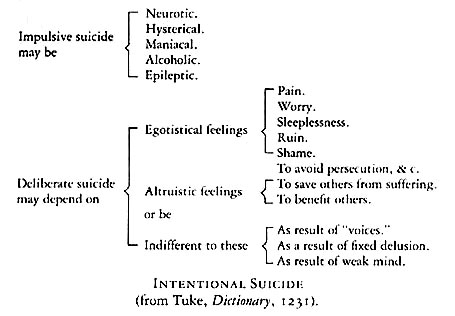
A Victorian chart analysing the causes of suicide: Nancy was deemed "Insane in mind" instead of the verdict "felo-de-se", deliberate, "intentional" self murder, which was still considered a crime in 1856. You were a criminal, by law, if you failed and insane if you succeeded (source: Victorian Web)
Thankfully, unlike many who were not permitted to be buried in "consecrated ground," I finally found Nancy's grave in the churchyard at Barlby, where, in the sad years that followed the "melancholy act," she was joined by her daughter Charlotte Vollans who died just after her 38th birthday in 1858 and Nancy's widower Thomas, who died in September 1861 and whose body was transported from his farm in Hatfield Woodhouse to lie beside Nancy near the home they once shared.


Sacred
To the memory of
Nancy the beloved wife of
Thomas Turner of Barlby farmer
Who died January the 27th 1856
Aged 66 years
Also Charlotte Vol(l)ans daughter
Of the above named Nancy and 
Thomas Turner who departed this
Life June the 15th 1858
Aged 38 years
Also the above named
Thomas Turner
Who departed this life
September 6th 1861
Aged 77 years

Tuesday, 27 September 2011

Walking into the Silence: Suicide and Secrecy in Victorian Yorkshire Part 1


This image from the 1851 census is a snapshot frozen in time.


It shows the occupants of a farm next to the Manor House in the little village of Barlby in Yorkshire, England. The head of household and his wife are my 5x great grandparents, Thomas Turner Snr,  farmer of 166 acres and Nancy, nee Pattrick, a waterman's youngest daughter from Thorne near Doncaster.


Also at the farm that night are Joseph Vollans, who studied farming and husbandry with Thomas and married his youngest daughter Charlotte. Their children are Mary Ann, Thomas and baby Elizabeth, not yet a year old.

This splendid photo shows Joseph in old age, long after the tragic events that tore the family apart just five years after this census was taken, which he almost certainly witnessed.

Joseph Vollans 1822-1901 my great great great granduncle
The other occupants include Charlotte Barrass, my great great grandma aged 15. Her mother, Hannah, was the Turner's fourth child and had married my 3x great grandfather, keelman Samuel Barrass. Life on the keel and waterways affected Hannah's fragile lungs and she died aged just 28 on Christmas Eve 1843, when Charlotte was just 7 and her two brothers even younger. While the boys could survive onboard the boat, Charlotte came to live on her grandparents' farm instead.

The census also shows local born farm servants George Baxter and John Wilson and the house servant, an Irish lass called Mary Wolder.

Next door, Thomas Turner Jr is farming alongside his father. The eldest son William and his wife Helen were farming back in Hatfield Woodhouse near Doncaster, looking after his father's other property. The family had moved north from Hatfield to Barlby when Thomas and Nancy inherited some money around 1829. Most of the household would be forced to return there when tragedy overtook them.

Thomas Jr's wife Mary Ann, nee Sampson, was a sloop owner's daughter from Hull. Her younger sister Charlotte, also living with them on census night, would later marry her brother in law when Mary Ann died young in 1853. Thomas and Mary Ann's children, George, Charlotte, William and Thomas complete the happy family circle gathered round the table in the farmhouse kitchen.

Modern map of Barlby, often flooded by the River Ouse
That veneer of happiness and prosperity wasn't to last.

My Dad could not even remember his grandparents' names. There seemed to have been a split in time somewhere. Roots had been rubbed out, stories left untold. Even Dad's oldest living cousins seemed only to have vague memories of my great grandfather Thomas Barrass, a farmer, Charlotte's illegitimate son, born in 1857.

He had never told his children anything of his past. At first I wondered why this settled domestic idyll was something he would be reluctant to recount. Even his own birth, 'out of wedlock' as the saying went, before his parents' marriage, didn't seem fully to account for the information vacuum.

Brambles and briars in a corner of Barlby churchyard

On a bleak midwinter Sunday, 27th January 1856, Nancy, aged 66 took a blade and slit her throat.

When I first set eyes on her death certificate, expecting to see she had died quietly in her bed, a shock wave reverberated through every cell of my body. Slowly, as I pieced the truth together, everything began to fall into place.

Since that awful day, the family began to fall apart. They seem to have spent generations moving away from the horror of Nancy's choice and burying the past under layers of silence, like ripples moving out from a deadly stone dropped without warning.


No inquest exists. I still hope one day to uncover some account in a newspaper from the time.

Chillingly, the death certificate was not issued until two months later, in late March. Suicide was a crime and shrouded in shame and superstition back then.

Were widower Thomas and the family under suspicion? Was she found right away? How, where and when was she buried? She was deemed to be "insane in mind". That was the conclusion for almost every suicide. To take your own life was thought to indicate a want of all reason.


No grave exists. Suicides could not be buried in consecrated ground. Back in history, superstition and fear would have them buried at a crossroads with a stake through their heart to prevent the troubled soul's return. The family had to carry this with them all the days of their lives. No wonder they left the village and the pitying, questioning eyes of their neighbours.

All Saints Church at Barlby - but where is Nancy buried?
Joseph Vollans' wife Charlotte died shortly afterwards after months of disabling diarrhoea. One of their children ended his days as a young man in Rotherham Workhouse, labelled an imbecile. Other grandchildren emigrated. Those who were left tried to forget and move on as the silence that I inherited deepened with the years.

I've returned to Barlby in recent years and left a circle of white Yorkshire roses around a stone font in the churchyard there. It was my way of trying to show how our family's love and my celebration of Nancy's place in my genes and genealogy is precious and still means the world to me. I think our backs had been turned in shock and grief for a century long enough.


A postscript to this is the strangest thing that has ever happened to me in all the course of tracing my roots. I was invited to go with a local Women's group to Laughton-en-le-Morthen church one summer evening. There was to be talk about the church architecture, all flying buttresses and Green Men. I had no connection to Laughton, so I thought. But I took my digital camera. Light was failing when we arrived. On a whim, the only grave I snapped belonged to Matthew Pearson, of Selby, born in 1784. I took it solely because I knew Selby was close to Barlby where the Turners farmed, and because Matthew Pearson had been born around the same year as Thomas Turner. 

Grave of Matthew Pearson of Selby, the Coroner who attended after Nancy's suicide, unbeknown to me when I took this photo miles away at Laughton-en-le-Morthen near Rotherham
I thought no more of it. Until a month or so later, when I opened the envelope from the General Record Office containing Nancy's death certificate. I had already been searching for it for years with no luck.


After the shock of the cause of death, the name of the Coroner who investigated the tragedy was what struck me most deeply. It was this very Matthew Pearson, the Selby coroner, whose grave I had captured on film for no reason I could ever have explained till then.


Rest in peace, Nancy. The choices you made, your marriage, your children, even the last sad decision, have helped shape my own story. If I could turn back the clock and the calendar, run back into history, perhaps I would gently try to tell you that tomorrow is another day and help you hope in your own happiness. Tell you it would all turn out right in the end. Perhaps as I left you, I'd whisper in the ears of the rest of the family, to please, please, hide all the knives and razors. But I know and believe you're at peace and your agony long past and healed by love and forgiveness.


You and yours will never be forgotten.

Extracts from my 5x great grandfather Thomas Turner's will:


I respectfully request that my landlords will permit my said son Thomas Turner to continue to occupy the farm which I now rent and occupy of them situate at Barlby aforesaid or in that immediate neighbourhood.

I charge all my real estate situate at Thorne in the said county of York with the payment of the annual sum of five pounds to my granddaughter Charlotte Barrass during her life and I direct that the same shall be paid to her quarterly, the first quarterly payment to be made at the expiration of three months after my decease and I also give and bequeath unto my said granddaughter Charlotte Barrass the whole of my household furniture plate linen and china which may be in my house at Woodhouse at the time of my death for her own absolute use and benefit.

I give and bequeath unto my said son Thomas Turner the whole of my farming stock, implements in Husbandry and valuation in upon and about the said farm which I now occupy at Barlby aforesaid, for his own absolute use and benefit subject nevertheless to the payment of the legacy or sum of one hundred and fifty pounds to my son William Turner which I direct shall be paid by my son Thomas Turner out of my personal estate hereinbefore devised to him and which I direct shall be paid to my said son William Turner within six months after my decease.

Marriage certificate of Thomas & Nancy's youngest daughter Charlotte to Joseph Vollans

...and to my five grandchildren the children of my late daughter Charlotte the wife of Joseph Vollans the legacy or sum of fifty pounds each and I direct that in case any of the said legatees shall happen to die before they shall become entitled to the bequests hereinbefore made to them having any child or children then I declare it to be my will and mind that the child or children of any of the said legatees so dying as aforesaid shall take the share or shares of its parent so dying in equal shares and proportions on their severally attaining the age of twenty one years and I direct that in case any of my said legatees or any of the children of the said legatees so dying as aforesaid shall not have attained their said age of twenty one years at the time the bequest hereinbefore made shall become payable to them.

Thomas Turner's death certificate. The witness was a relative of his daughter Elizabeth, who had married George Chester, a village butcher in Finningley, but predeceased her parents. I cannot find Thomas's grave, either, and wonder if he chose to be buried wherever Nancy was secretly laid to rest?

Thursday, 13 May 2010

What I don't know about wet collodion and Victorian post-mortem photography

I'm just working on a short story about an itinerant photographer who travels with his tripod and cumbersome portable dark room from village to village producing snapshots of the locals. I won't spoil the plot in case it is published one day, but basically, the sittings in one village lead to a crime, after which the young ambrotypist is called on to take an early post mortem photograph for the local constabulary.

I feel most alive when I am writing and never cease to marvel how much we can learn from researching our stories. In the course of researching this story, for instance, I've been discovering the developments that took place in the 1850s, when the early Daguerrotype process was improved on by the wet collodion process, particularly popular for its quick, cheap "instant" results. This meant that the image could more easily be replicated from a single negative. The glass plates for wet (and later, dry) collodion photos were also more readily available than the older silver-plated copper.

But its usually true of the research we accumulate for storywriting that it's better left in the background, to inform rather than hijack the tale. You DON'T want to know all about coating glass plates with silver nitrate and the dangers of working in a confined space with acid, bromide, iodide salts, alcohol, ether and goodness knows what else! Still less will the reader want to know about the gruesome fashion for "post mortem" photographs I've just discovered while striving for background knowledge. I now know that Victorian mourners often had their lately deceased loved ones photographed for posterity, even having "eyes" painted on the closed lids for a more "lifelike" effect! Some of the many existing examples of these memento mori are the stuff of nightmare and have no place in my own tale. Facts are facts, and anyone can pursue them. What the readers long for is a tale to inspire them, transport them. They want to know "Who did it?", or "Do they get together in the end?" or to encounter a host of other life-enhancing, challenging moments that only fiction can nudge their way.

What a joy and a journey! The challenge I've set myself in this story is to try to let the reader see through the eyes of the camera what is really going on under the surface. Of course, being me, on the way I inevitably become voracious gobbler of weird and wonderful facts that get stored away in my brain and imagination. Sometimes these things lead to other stories I never would have planned, often more intriguing than the original idea! Stories, like ourselves as writers and readers, are always open to evolve and change as we interact with God's glorious, endlessly gracious creative power. Stories give us space too to fix a snapshot of some truth within the rainbow of possibilities, developed like the photographer's negatives exposed to the sunlight of the human heart.

From the Open University's Learning Space "Arts and History" Unit on "The rise of the itinerant photographer": Image 78: Photographer/Painter: John Thomson. Subject: The Itinerant Photographer on Clapham Common’, from John Thomson & Adolphe Smith, Street Life in London, 1877/78.

(One of many excellent sites used during my research for the story mentioned in this post)